The aim of the project was to produce a completely new dilute sulphuric acid distribution pipeline for a biotechnology company in Finland.
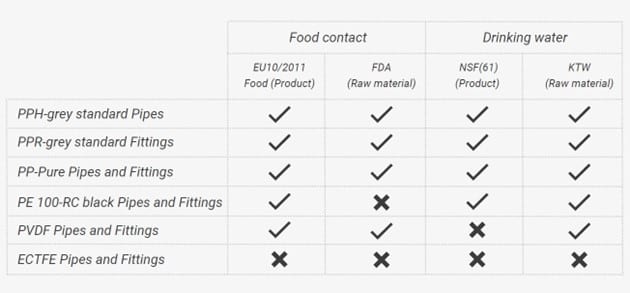
An important criterion for material selection was the suitability of the material for the food industry, i.e. the material used had to have the necessary food approvals.
Material selection
The company’s end products are an important part of the food industry, so the materials used in the dilution piping must be food-approved. Due to the precise production process and high quality requirements, polypropylene (PP) was selected as the material suitable for the process.
PP is one of the most widely used plastic materials in industrialised countries. It has a very good chemical resistance to acids, bases and solvents. Compared to other thermoplastics, PP has a better temperature resistance, withstanding temperatures of almost 100 °C. Polypropylene has excellent abrasion resistance. In addition, the smooth inner surface of the pipe prevents the formation of deposits, which supports its suitability for the food industry. Typically, polypropylene is used in process piping and as a structural or lining material for tanks.
EU Regulation 10/2011 sets safety requirements for plastic materials and articles that come into contact with food. This Regulation is a specific measure in the European framework Regulation EU 1935/2004 on plastic food contact materials. Only authorised substances may be intentionally used in the manufacture of food contact materials and articles.
Polypropylene is physiologically non-toxic. It meets the relevant EU and FDA (Food and Drug Administration) food standards.
For food-contact applications, the use of diaphragm valves is recommended. The use of diaphragm valves has many advantages. They completely isolate the shut-off part from the control mechanism, which prevents any substance from entering the valve’s operating parts. In addition, they are leak-proof, easy to operate and maintain and are food-approved.
Material suppliers
The pipes and fittings imported and used by Atolli Oy are from well-known European plastic companies. Thanks to the strict quality standards of our suppliers, we can offer reliable products that make installation safe and consistent. The pipes and pipe fittings for this project were supplied by the Austrian company Agru Kunststoftechnic GmbH. Agru has verified the suitability of its raw materials for the food industry and tested the finished products to ensure quality at an independent testing and research institute in Vienna.
Installation
The installation of the dilute sulphuric acid line was carried out by Atolli Oy’s professional installation team. The installers who made the pipe joints have a training as installers of thermoplastic pipelines and more than 2 years of experience in welding plastic pipelines.
The welding method used in this study is infrared (IR) welding, which is particularly suited to the needs of the food industry. In IR welding, the surfaces to be joined are heated by infrared radiation without the welding mirror touching the surfaces to be joined. The method is based on a similar principle to butt welding, but the temperature used in IR welding is higher and the welding time is considerably shorter. This makes the process more efficient and makes welding more environmentally friendly.
IR welding was chosen for this work for a number of reasons, particularly related to the requirements of the food industry. The method offers several advantages, such as low burr, high purity and full automation. Full automation ensures not only high process quality but also documentation, which is critical in food production where traceability and quality control are key. With IR welding machine automation, welding success is assured if the conditions, cleanliness and data provided are set correctly. This prevents incorrect welding results.
A particular benefit of IR welding on this site was the hygiene and high weld quality it offered. As no adhesives, additives or foreign materials are used in the process, the risk of contamination is significantly lower compared to other welding methods. This makes IR welding a particularly suitable welding method for applications with high quality requirements.
To ensure safety, safety gutters were installed around the pipes along the access routes. The safety gutters protect the surrounding environment from possible splashes and spillages. In addition, the safety troughs ensure a continuous spur, which further improves the safety of the environment.

Documentation
Atolli Oy delivers the documentation of all projects to the customer after completion of the work. The documentation of this project follows the documentation guidelines of Tukes’ guide Chemical Thermoplastic Piping Systems.
Tukes is responsible for chemical safety and the supervision of technical products and their safety. In the case of chemical thermoplastic pipelines, documentation in accordance with Tukes plays an important role, particularly with regard to safety requirements for pipelines used in industry and for the transport of dangerous substances. The related standards and regulations ensure that plastic pipelines are safe, durable and suitable for their intended use, including in the food industry where chemical properties are of particular importance.
The documentation prepared for this work includes, among other things.
- Declaration of Conformity
- product list
- risk analysis
- material certificates
- welding instruction and welding seam reports
An important addition in this project was to add food approvals for the materials to the documentation.
Tukes’ documentation guidelines provide a wealth of information on how industry can ensure that thermoplastic piping systems meet safety and quality requirements. It provides concrete guidance on choosing the right plastic grade and welding method, as well as on how to maintain and inspect the pipelines.